Working at the National Aquarium!
Sunday:
A one and half hour flight from Boston has landed me in Baltimore. The Land of Crab, The Orioles, and most importantly for our purposes, the National Aquarium. Sea Rovers Associate Holly Bourbon, who works as the Director of Dive Operations at the National Aquarium, picked me up from the airport. Holly and her husband, Billy, have been incredibly hospitable, referring to me as their “Insta-kid” (just add water) for the week. Being seasoned Intern hosts, they definitely have the drill down pat by now. Since working at the National Aquarium, the Bourbons have opened their home to ten interns, making me the eleventh. They are incredibly caring people, and it is no stretch to say that the internship is so fantastic because of the kind of people they are and the opportunities they provide.
Monday:
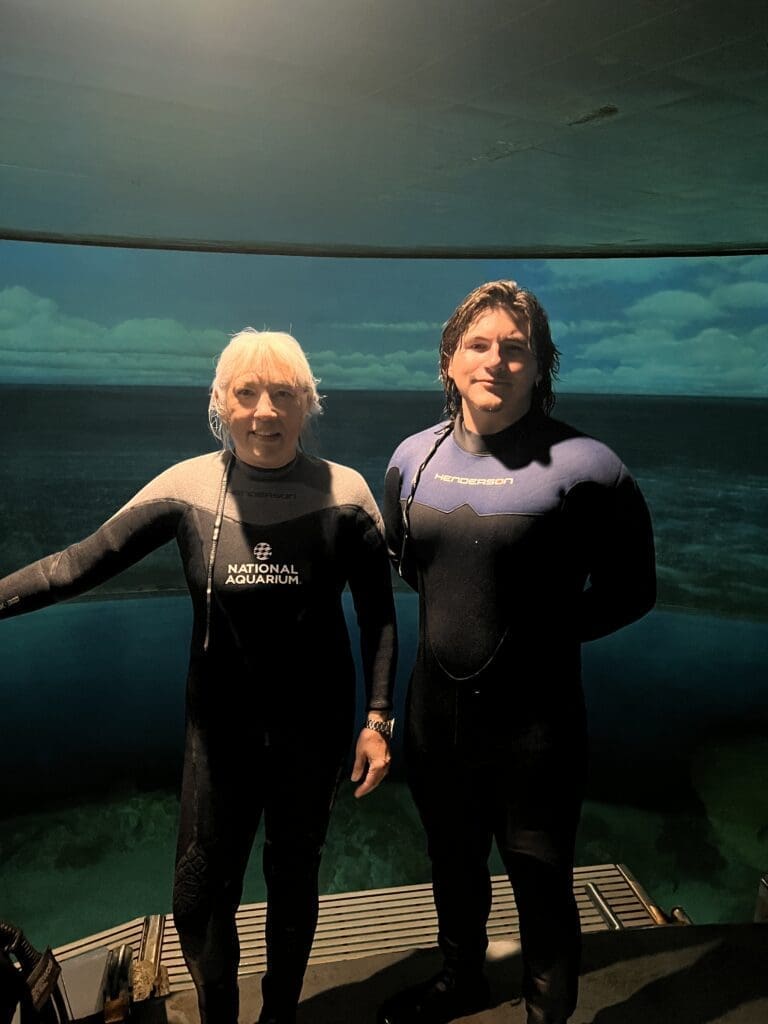
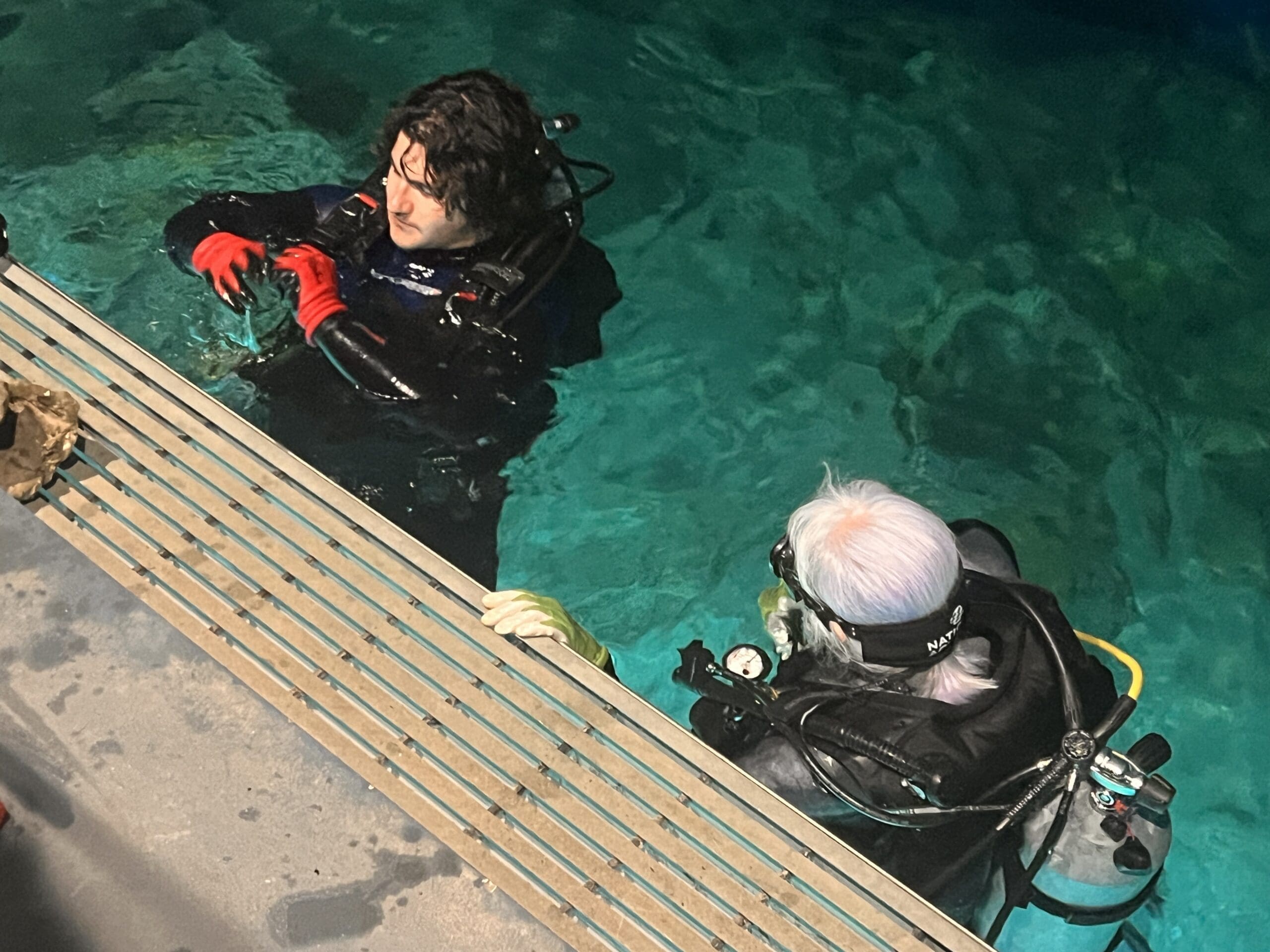
Early Monday morning, we started with a check out dive in the Atlantic Coral Reef (ACR) habitat. This was to review basic skills, which was needed because I was borrowing gear from the Aquarium, diving in the habitats, and it was my first time using a jacket style BCD. After basic skills were reviewed, we moved to one I had never done before. A large board was hung from the swim platform with 9 different holes in it. Each hole corresponded to a peg that had a word or shape on it. Square peg goes in the square hole, shocking I know. It was a fun exercise that is designed to teach divers how to manage their buoyancy while performing tasks. A similar principle to training with task overload as science divers do. I loved the ACR because I had just seen many of the same animals in Little Cayman at the Backscatter Digital Shootout. It’s interesting to compare animals in the wild who swim away the second they see you, to animals who are in captivity who couldn’t care less about you. Unless you have food for them, of course. When I was in Little Cayman at the Backscatter Shootout I really really wanted to get a shot of a pufferfish’s eye. A lot of other people were able to utilize esoteric scuba-ninja skills to sneak up on them and accomplish the shots I wanted. Unfortunately, esoteric scuba-ninja skills are not part of a training course, but something to develop over time. However, in the ACR no ninja skills were needed, the entire time I was doing the peg board task I had a puffer fish staring me down. It was like I had taken this guy’s parking space, he would not leave me alone. Holly later explained to me the same bucket that the pegs were being stored in was similar to his food container. This poor pufferfish probably thought I was setting up the world’s most complicated KONG toy! (They do have those here).
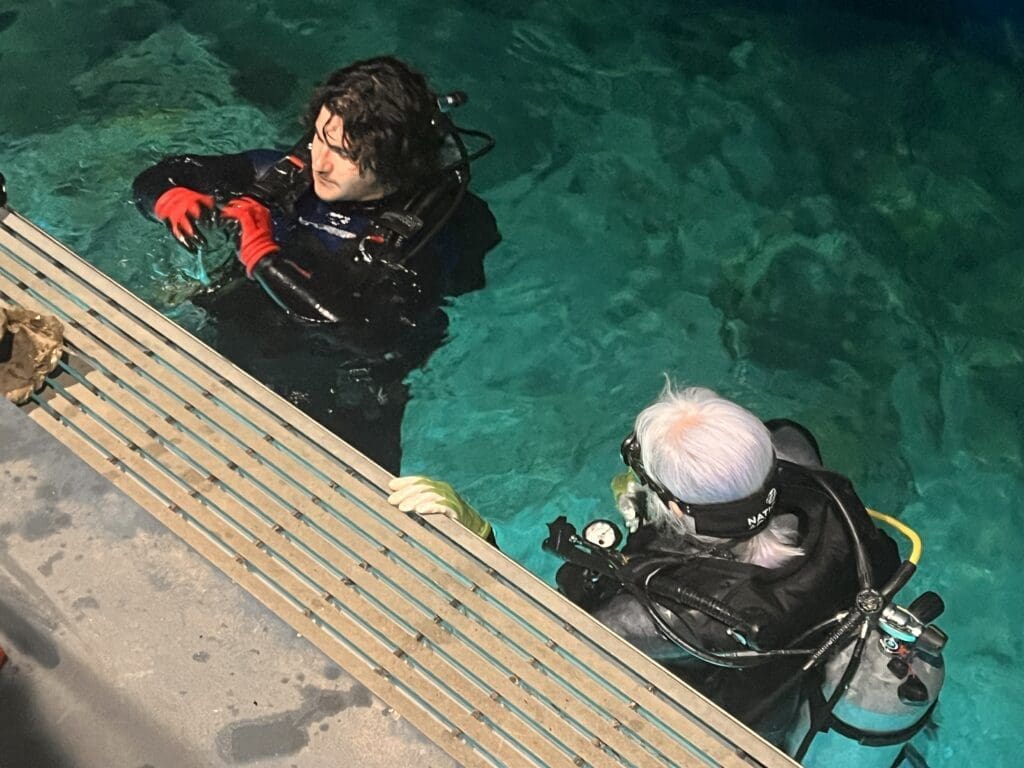
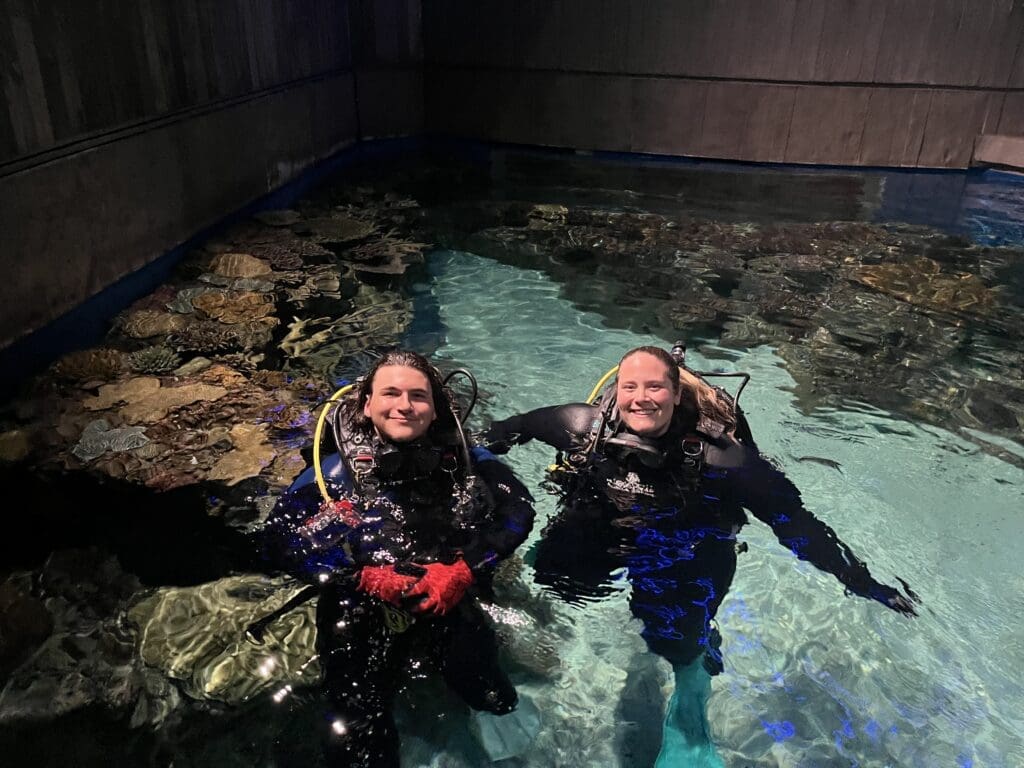
After our skills we then began a lap of the ACR, diving in an aquarium was both incredibly amazing and disorienting. It was weird being in the water and looking through a window. As we swam through I saw moray eels, the aforementioned porcupinefish (puffer), black grouper, and many many more. There is one section where you have windows on both sides and you can see guests walking around 30 feet below you. You can see them peer into the BlackTip Reef habitat and point at the zebra sharks. After work we headed back to the Bourbon’s. After assisting in watering their garden we made dinner and watched the world cup!
Tuesday:
I started off Tuesday by getting a tour of the behind the scenes animal care areas. A lot of this consists of water monitoring and treatment. Lots of various life support systems are put into play to keep the animals within their individual ranges of environmental tolerances. Animal welfare is one of (if not the) biggest concern for the National Aquarium. After speaking with many different aquarists all of them have essentially said the same thing, it is their duty to provide the best quality of life to the animals while in the care of the Aquarium. I’ve learned that care comes in many ways and many different departments must collaborate to accomplish their common goal. To a visitor it’s probably not apparent how much work and maintenance goes into an aquarium.
Habitat builders and mechanics need to make sure that the habitat is custom and fit to what animal it is housing. They need to make sure all life support is constantly running and do water quality analysis regularly. They need to build contingency plans if the aquarium were to ever lose power. And this is just one department. All habitats need proper feeding and nutrients which are managed by each habitat’s respective team.
I also got to dive in the BlackTip Reef habitat. Holly was generous enough to lend me her camera so I was able to get a few videos while there. The BlackTip Reef (BTR) was amazing, it is an Indo-Pacific reef that houses four rays, two zebra sharks, four blacktip sharks, two wobbegong sharks (and a partridge in a pear tree), as well as many other species of fish. It has an above viewing area as well as an underwater viewing area. It felt like a very full circle moment to be able to wave at and fist bump kids through the glass. I remember being at the Georgia Aquarium and watching as the divers scrubbed the tanks. It was very fulfilling to be able to be on the other side of the glass.

After making a pit-stop at the Bourbon’s we headed over to the Orioles game. And so I prepared myself to enter enemy territory… Camden Yards is beautiful and a statue of Babe Ruth welcomes visitors. The l field is installed beneath the ground which gives you a fantastic view of the field straight from the gate. The home field traditions were in full effect with condiment races (mustard won) and different chants. The Orioles lost to the Chicago White Sox and we headed home.
Wednesday:
By Wednesday, we had really gotten into the groove. Wake up, make coffee, hit the road, start up the dive systems, drop my backpack off in Holly’s office, then head back to the dive locker for the morning meeting. It feels good to have some routine after the first couple of days of figuring everything out. Instead of wondering what comes next, I can focus on learning, helping wherever I can, and paying closer attention to how everything operates behind the scenes.
One thing I have really come to appreciate is Holly’s leadership. Every morning she starts the day by gathering everyone together and laying out the plan. She goes over everyone’s goals for the day, explains the inevitable changes that have come up, discusses what needs to be prioritized, and makes sure the entire team is on the same page before anyone heads off to work. What stands out the most is that she gives every member of her staff the opportunity to speak up with concerns, suggestions, or ideas about the day’s dive operations. It creates an environment where everyone feels heard and where communication flows both ways instead of just from the top down.
After many years in the business, Holly seems to have perfected the role of a manager. She wears many hats throughout the day, balancing administrative work, scheduling, planning, and overseeing dive operations, but she has both told me and shown me that she would never ask someone on her team to do a job she wouldn’t be willing to do herself. As the director, she could easily spend all day behind a desk while others handle the physical work, but that is not the kind of leader she is. She genuinely cares about the mission and the shared goals of the dive team, so whenever an extra set of hands is needed, she steps in without hesitation. Whether it is helping prepare for a dive, assisting with equipment, or jumping into whatever task needs to get done, she leads by example. It is the kind of leadership that earns respect naturally and elevates the performance of the entire team.
Today’s schedule included a lot of fish feeding. I got to spend some time working with the aquarium kitchen preparing food for the day’s feedings. That meant cutting up crabs, squid, and various fish, carefully weighing each portion, and placing everything into the correct buckets to make sure every animal on exhibit received the proper diet. It was another reminder of just how much work goes on behind the scenes before visitors ever walk through the doors. Every bucket was labeled and portioned with a purpose, and every animal has different nutritional needs that have to be met consistently.
Later on we fed the animals in Shark Alley. Above the exhibit is a narrow catwalk where the aquarists use long metal feeding poles to offer food to the sharks from a safe distance. Watching the sharks confidently swim up and bite down on the end of the pole was an impressive sight. It is one of those moments that reminds you just how powerful these animals really are. Thankfully, a shark clamping down on a metal pole is a whole lot better than clamping down on your arm.
Thursday:
Today I had the opportunity to participate in a DAN (Divers Alert Network) First Aid training course. I had already completed the required online e-learning portion a few weeks earlier, so the goal of the in-person class was to put that knowledge into practice through hands-on training and to review the material in greater depth. Since DAN certifications must be renewed every two years, most of the people in the class had already completed the course several times before. It was interesting to learn alongside such an experienced group because many of them shared real-world stories and practical advice that went beyond what was covered in the online modules.
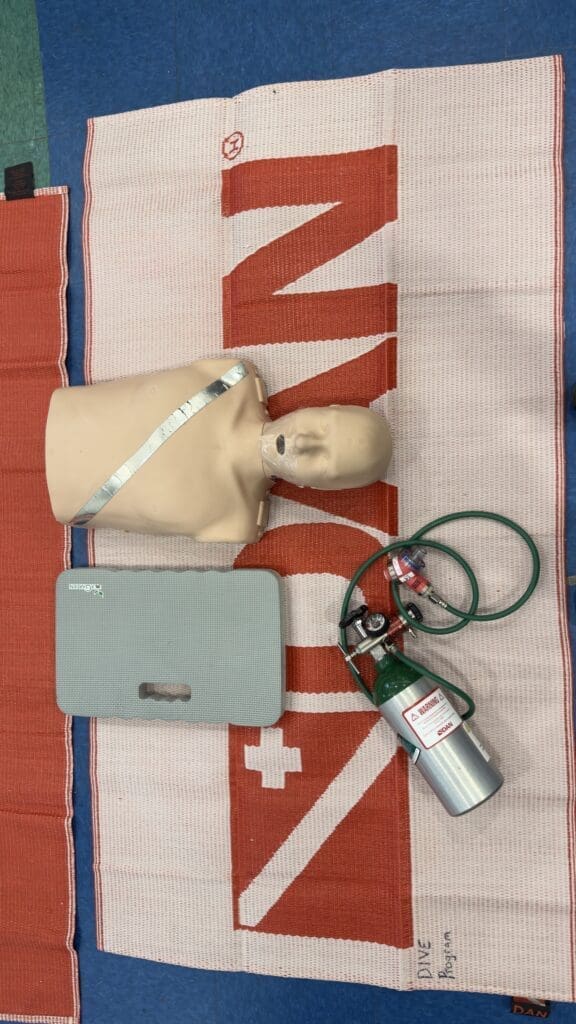
The class ran from 8:00 AM to 3:00 PM and covered a wide range of emergency response topics that are especially relevant to divers and aquarium staff. Throughout the day, we practiced CPR for adults, children, and infants, learned how to properly use an AED, reviewed techniques for responding to FBAO (Foreign Body Airway Obstruction), and trained in administering emergency oxygen. We also covered general first aid, neurological assessments for injured divers, and the proper treatment of hazardous marine life injuries. Rather than simply listening to lectures, much of the day was spent practicing these skills repeatedly until they became second nature. Having the opportunity to physically perform each skill made me feel much more confident than I would have from completing the online coursework alone.
What was apparent was how seriously the National Aquarium approaches safety. With well over 100 active staff members and volunteers receiving DAN first aid training through programs like this, it is obvious that everyone is expected to be prepared to respond if an emergency occurs. Whether someone is diving in an exhibit, working behind the scenes, or interacting with guests, having so many trained individuals creates a much safer environment for both the staff and the animals they care for.
I felt incredibly fortunate to be able to participate in the course. Beyond earning another certification, I walked away with practical, life-saving skills that I hope I never have to use but am grateful to have. Diving carries inherent risks, and knowing how to respond quickly and effectively in an emergency is just as important as knowing how to prevent one in the first place. Completing this training has made me feel more capable, more prepared, and ultimately a more responsible diver. It is another step toward becoming someone that others can rely on when situations do not go according to plan.
Friday:
Today’s schedule gave me the opportunity to join several volunteers diving in the Atlantic Coral Reef exhibit. Our first task was retrieving a few empty habitats that had been used to introduce new fish into the exhibit several days earlier. It was interesting to see just how much planning goes into something that visitors probably never even notice. Every step is carefully thought out to make the transition as stress-free as possible for the animals.

The process of introducing a new fish into the exhibit is incredibly intentional. Rather than simply releasing a new arrival into the habitat, divers first place the fish inside a temporary underwater enclosure located within the exhibit itself. This allows the fish to gradually adjust to its new surroundings while also giving the other animals time to become accustomed to their new tank mate. After several days of acclimation, when the aquarists are confident that everything is going well, the fish is released from the enclosure and allowed to fully enter the exhibit. Once all of the fish had been successfully introduced, our job was to remove the temporary habitats until they were needed again for another introduction. After that, we moved on to scrubbing the exhibit windows. Divers use large suction handles (see picture) to anchor themselves to the acrylic while cleaning with long window scrubbers. The suction handles make it much easier to stay in one place without constantly finning, especially when you’re trying to clean a large viewing panel as thoroughly as possible. It may sound like a simple job, but keeping the windows spotless makes an enormous difference for the thousands of visitors looking into the exhibit every day. I think my favorite part of diving into the exhibits is getting to be part of the attraction. From the other side of the glass, you’re just another diver doing maintenance, but to all of the kids watching, you might as well be another animal in the tank. They wave excitedly, press their hands against the glass, and get so excited when you wave back. Seeing how fascinated they are makes even routine maintenance feel special. I even played rock, paper, scissors through the glass with the kids. It usually gets a big laugh from both them and their parents, and it is surprisingly good practice for maintaining buoyancy while you’re distracted. Holding perfectly still while trying to throw rock, paper, or scissors without floating away is a lot harder than it sounds! Moments like those remind me that working at an aquarium isn’t just about caring for the animals—it’s also about helping create memorable experiences for the people who come to see them.