BSR Flag#2-Britannic Expedition May 2019
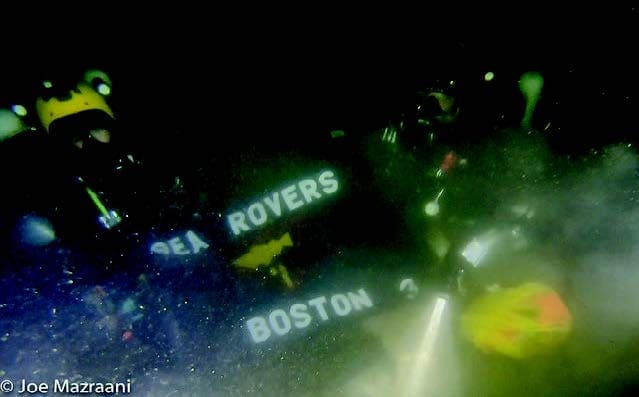
“As you descend, the water turns from pale turquoise to sapphire to an even deeper blue until out of the blueness you see her. All shipwreck divers imagine in their mind’s eye what a wreck will look like up close and in person, but nothing prepared me for my first glimpse of one of the world’s great ocean liners – Britannic. She is massive, mysterious, and perhaps most importantly, full of limitless opportunities for exploration and discovery.” – Joe Mazraani, Diver on Britannic Expedition May 2019.
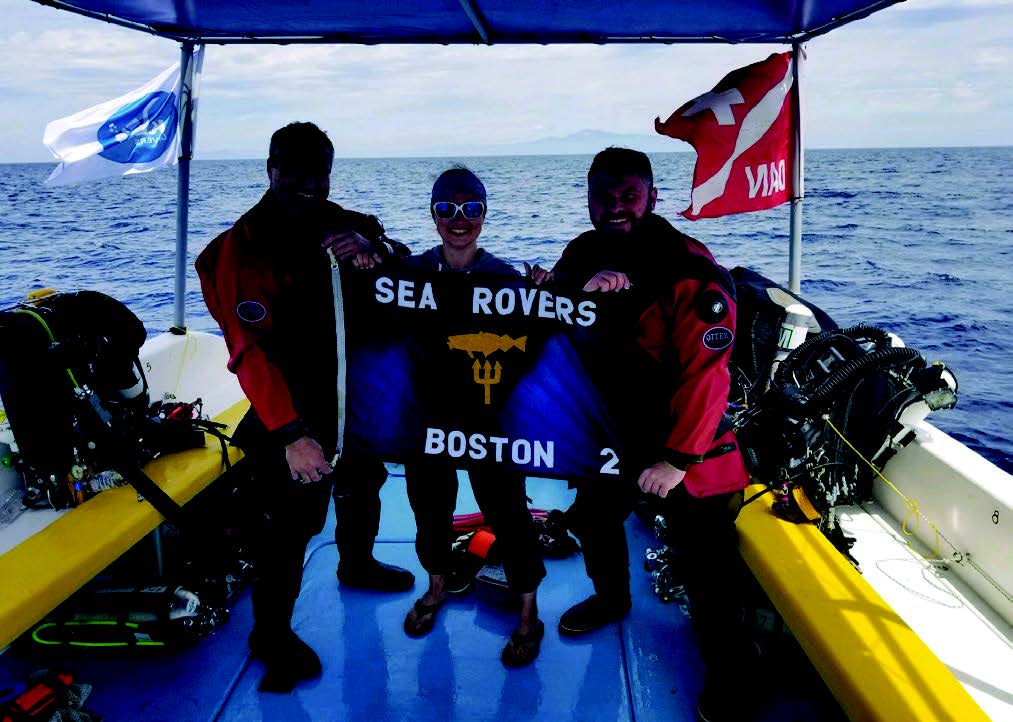
On May 10, 2019, a group of ten divers set sailfrom mainland Athens to Kea Island, Greece to dive the famed ocean liner Bri-tannic.Boston Sea Rover and Expedition Member RickSimon carried with him Sea Rover Flag No. 2.Veteran British ship-wreck diver Scott Roberts led the international team of divers that included Richard Ayrton, Luke Kierman, Jacob MacKenzie, Joe Mazraani, George McClure, Duncan McCormick, Steve Pryor, Rick Simon, and Scott Wyatt.
HMHS Britannic was the third vessel in WhiteStar Line’s Olympic class, which included Olympic and the most famous of the three sisters, Titanic. Unlike Titanic, Britannic never realized her potential for luxury because she was requisitioned by the British Royal Navy as a WW1 hospital ship shortly after her launch in 1914 and refitted for that purpose.On November 20, 1916, Britannic was carrying almost 1,100 seamen, wounded soldiers, and hospital personnel when she struck a mine laid by a German U-boat.
The blast flooded six of Britannic’s water tight compartments – damage more substantial than that which crippled Titanic but damage the ship was nonetheless designed to handle. The ship’s captain, Charlie Bartlett, ordered the ship to shore intending to run her aground on Kea Island. Earlier in the day and against standing orders however, the ship’s nurses had opened the portholes to ventilate the sick wards. Water came pouring through the open portholesas she steamed causing the ship to list. The disaster was further compounded by some who launched lifeboats against orders while the ship was underway. Those passengers were killed when they were sucked into Britannic’s enormous propellers. Captain Bartlett eventually gave the order to abandon ship, and more than1,000 people boarded the lifeboats from which they were soon rescued. Thirty perished, most of whom prematurely boarded the lifeboats.
The damage eventually sent the 50,000-ton Britannic to the bottom of the Aegean Sea. She currently lays on her starboard side in 116 meters (383 feet) of water in the channel between the islands of Kea and Makronisos. Many of her portholes are still open and her colossal propellers are still intact.
Blessed with unusually good weather, the expedition team made six dives to Britannic in an eleven-day period. This allowed them to explore, document, and photograph numerous areas of the vessel.

The team had the honor of being joined for a portion of the expedition by Britannic’s owner, Simon Mills. Mills’ passion for the ship and respect for divers were apparent as he delighted the team with stories about Britannic and of expeditions past, going as far back to the first dives led by Boston Sea Rover Jacques Cousteau, who found the wreck with Boston Sea Rover Doc Edgerton in1976. Mills is not just the owner of the ship but serves as an ambassador for her preservation. His spirit of exploration and decision to open the wreck to divers capable of exploring her mysteries made the team’s dives possible. A documentary crew from a major broadcaster also joined theexpedition. Their program will air within a year.
In addition to exploring Britannic, the group made two dives to SS Burdigala, a liner built by theGerman shipbuilder Schichau Werke for Norddeutscher Lloyd to be both fast and luxurious. In1912, she was purchased by Cie De Nav Sud-Atlantique, a French Line, and sailed under theFrench flag from port in Bordeaux. Burdigala sunk on November 14, 1916, just one week prior to thesinking of Britannic. The cause of her demise was a mine laid by the same U-boat as the one that laidthe mine that sank Britannic. This shipwreck was discovered more recently than Britannic and was not identified until 2008. A stunning sight, she sits upright on her keel at a depth of approximately 70meters (231 feet).
Dives like these are not possible without a tremendous amount of coordination, permissions, andsurface support. The team expresses their gratitude to the following people and organizations: theGreek Ephorate of Underwater Antiquities for granting permission for exploration and providing on-site archeologists to educate the team and monitor their progress; Mayor Ioannis Evaggelou of Keafor welcoming the team to his island paradise with open arms; Yannis Tzavelakos and his team atKea Divers for their logistical and surface support; and surface-team leader George Vandoros, whose professionalism and wisdom of experience inspired confidence in the team that those above water always had their backs.